The GUP Modular Platform
Samsara's R&D process adheres to rigorous environmental responsibility standards, with a strong commitment to sustainability and landfill-waste reduction.
The proprietary Green Upcycling Process (GUP) is the outcome of multi-year research focused on solving the key challenges of plastic-waste recycling. Designed as a modular system, GUP maximizes scalability and adaptability, enabling distributed processing and supporting multiple end-market applications.
Key Technological Innovations
Feedstock Flexibility
Our process accepts a wide range of plastic waste types that conventional recycling cannot handle, making it a true end-of-line solution for mixed plastic streams. Accepted materials include:
- Mixed flexible films (LDPE, LLDPE, PP)
- Rigid packaging (HDPE, PP containers)
- Multilayer and laminated packaging
- Agricultural plastics (silage wrap, greenhouse films)
- Marine-recovered plastics
- Post-consumer packaging with light contamination
- Non-recyclable composite materials
No Sorting or Washing Required
It can directly process mixed plastic waste streams (PW), including materials contaminated with labels, adhesives, food, grease, or organic residues.
Advanced Composite Engineering
GUP is a proprietary compounding technology that processes heterogeneous plastic waste streams—combining rigid and flexible polymers into a homogenized composite material with enhanced mechanical performance. The Sustainable Plastic Waste Composite (SPWC) exhibits improved compressive and flexure strengths, impact resistance, increased density, and ultra low water absorption, making it suitable for structural and semi-structural construction applications.
Controlled Thermal Processing
The GUP heat-transfer system is engineered with precisely controlled thermal zones to prevent polymer degradation and avoid combustion, thereby minimizing process emissions and maintaining CO₂ and other off-gas levels within National Institute for Occupational Safety and Health (NIOSH) recommended exposure limits. By eliminating uncontrolled burning, the process avoids the high emissions of plastic incineration and physically sequesters carbon within the composite matrix. This controlled retention is the primary technical driver behind EcoBrik's verified carbon-negative lifecycle.
Superior Material Versatility
SPWC outperforms wood and concrete in wet and coastal climates. Its exceptional resistance to salt and moisture ensures long-term reliability for fencing, roofing, siding, and bricks, making it the ideal sustainable choice for harsh environments.
Zero Waste Manufacturing
The production cycle functions as a high-efficiency closed-loop system in which all process scrap and off-spec units are reground and immediately reintroduced into the extrusion process, ensuring a zero-waste manufacturing cycle. In addition, GUP technology enables the direct upcycling of non-ferrous construction waste into the composite matrix. By incorporating these mineral aggregates, the process significantly reduces reliance on virgin materials.
Modular System
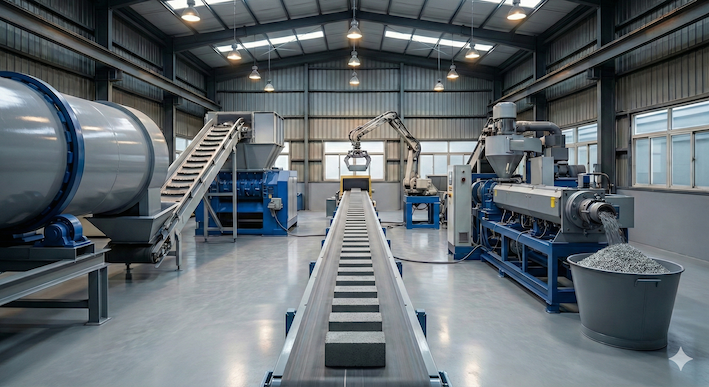
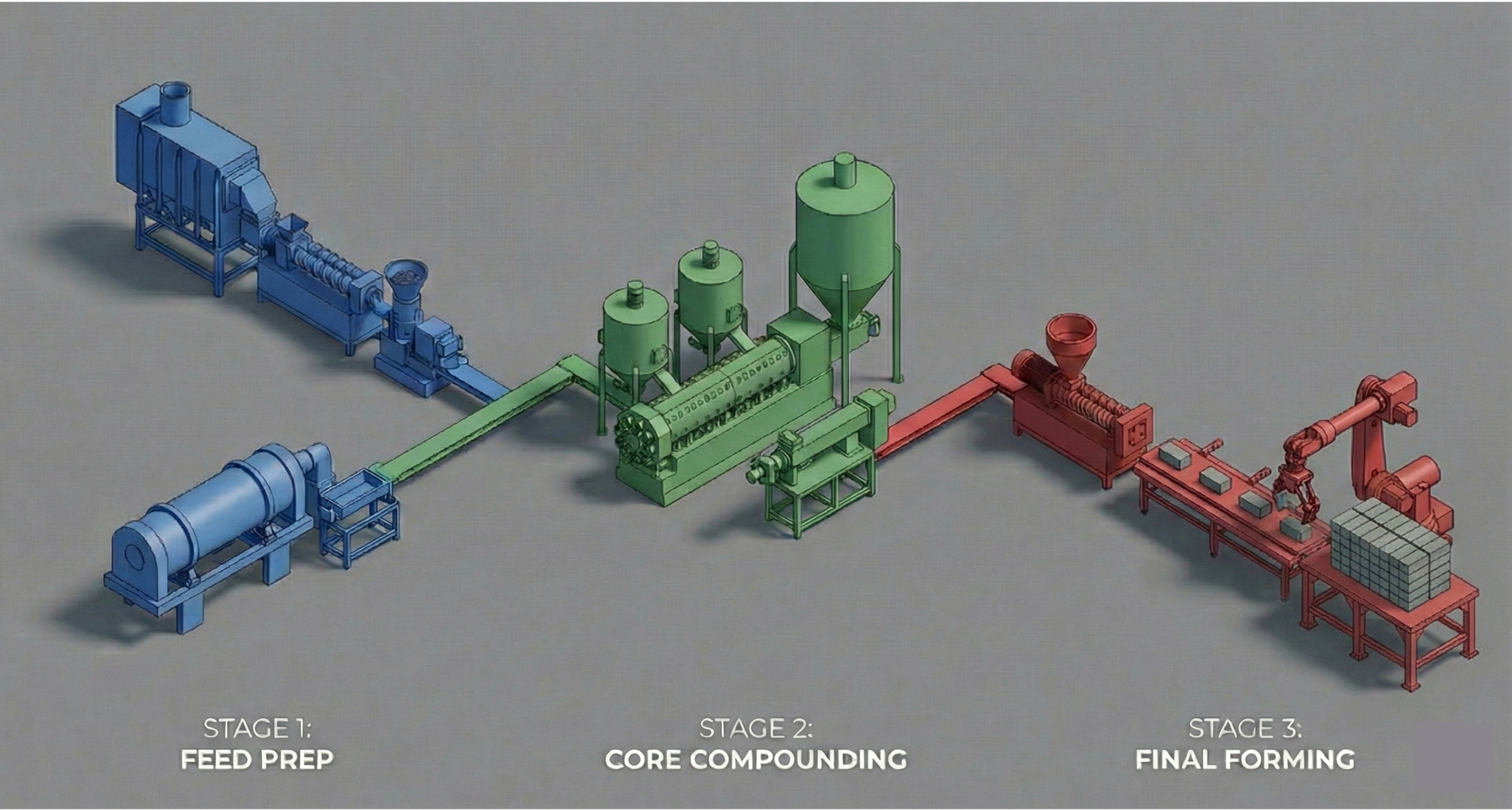
The GUP entire system can be all installed in one plant or detached into three modules: Pre-compounding, Compounding and Forming. Its modular design allows distributed processing, increases operation efficiency, and maximise scalability.
Distributed Processing
The distributed processing feature allows partnership between cities, co-op and entrepreneurs to reduce their respective labor costs and efficiently manage the flow of PW through their respective plants.
Pre-Processing Module
The pre-compounding module can be installed at a city Material Recovery Facility (MRF) or at an agricultural co-op, where plastic waste (PW) is collected, sorted, and recyclable fractions are shipped to conventional recyclers. Instead of shipping non-recyclable and non-chemically contaminated PW to landfills, these PW can be preprocessed and sent to Samsara's compounding center.
Because PW is not shipped daily, it typically occupies significant space at the MRF. Reducing this material into uniform, small pellets minimizes storage requirements, eliminates odors, and significantly reduces the need for pest control.
Compounding Module
Pre-processed PW from the compounding module becomes chemically transformed into a new class of plastic with higher heat tolerance while preserving the necessary binding properties. These modified properties enable Samsara's GUP technology to combine controlled heat transfer with high-shear mechanical processing, allowing the material to bind effectively with aggregates and form SPWC.
Forming Module
SPWC is fed into a forming module to manufacture end-market products such as EcoBriks, EcoPosts, EcoSiding, EcoBoards, and EcoShingles, tailored to local market needs. The structural and mechanical properties of SPWC meet the most stringent brick standards, making these products safe and reliable replacements for conventional alternatives.
Flexible Expansion
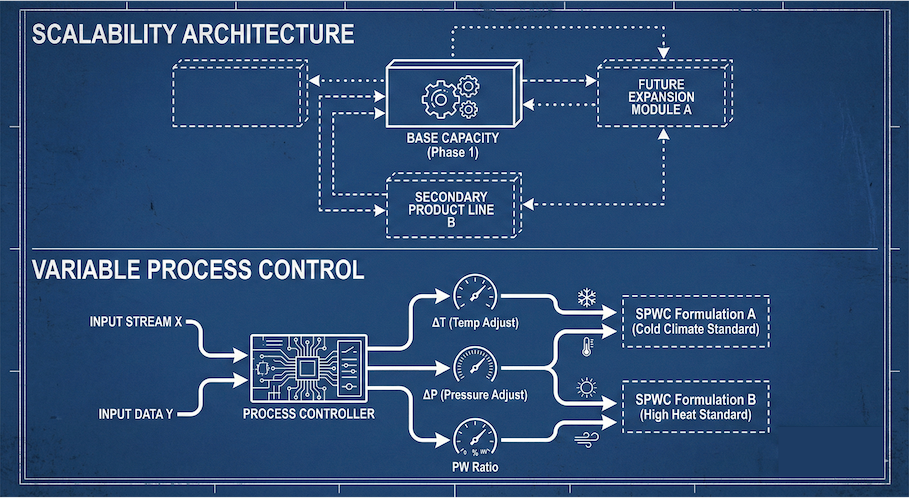
Initial modest CAPEX enables operators to start with minimum capacity and gradually expand capacity or product lines.
Localization
Temperature, pressure, and PW ratios are fully controllable variables, enabling the formulation of SPWC to be adjusted to meet the requirements of specific jurisdictions.
Interested in Our Technology?
Schedule a technical consultation to discuss licensing opportunities, partnership models, or custom material development.